
Prosthetic Components Used in the Dental Implant Process
Introduction
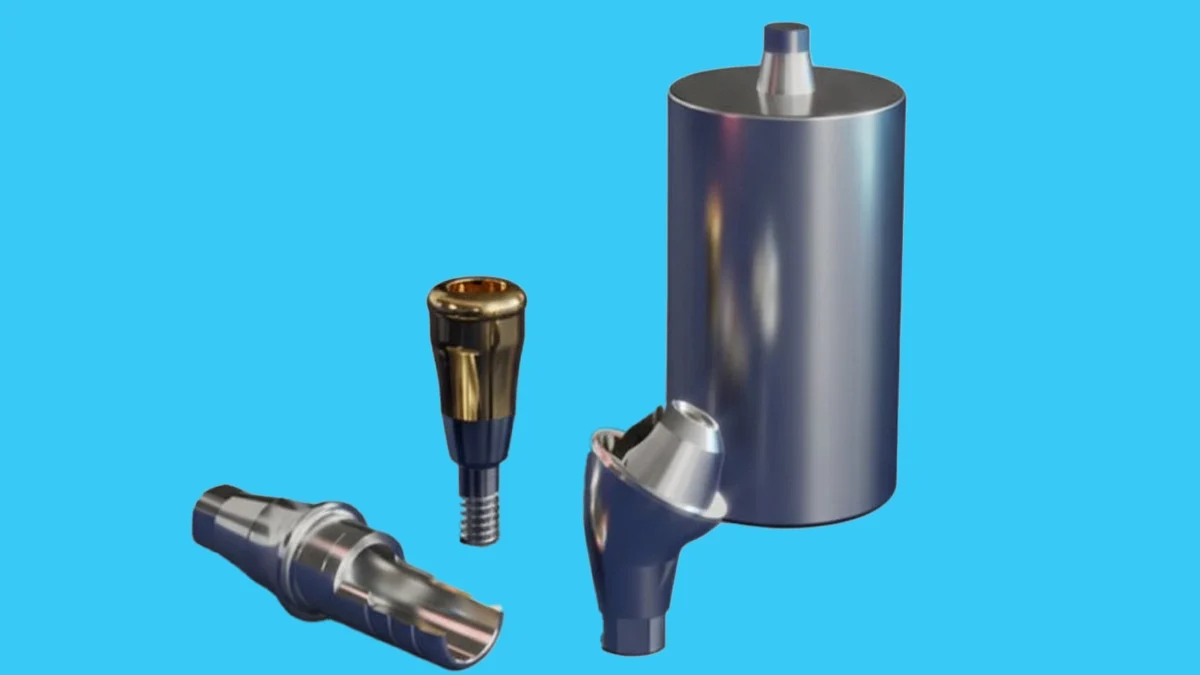
Dental implantology has revolutionized restorative dentistry by providing patients with functional, long-lasting, and aesthetic tooth replacements. However, successful implant treatment depends not only on osseointegration but also on the precision and compatibility of prosthetic components that connect the implant to the final restoration.
This article provides a complete overview of the main prosthetic components used in implant dentistry, their functions, and how they contribute to the success of implant-supported restorations.
1-Understanding Implant Prosthetics
After the implant fixture is placed and integrated with bone, a series of prosthetic components are used to transfer the implant position, shape the gingiva, and support the final crown, bridge, or denture. Each component plays a vital role in achieving optimal fit, stability, and aesthetics.
2-Key Prosthetic Components in the Implant Workflow
a-Healing Abutment (Healing Cap)
The healing abutment is a temporary component placed after the implant has been exposed during the second-stage surgery.
Purpose:
- Maintains soft tissue contour during healing.
- Shapes the gingival architecture for a natural emergence profile.
Materials: Titanium or titanium alloy; sometimes anodized or coated for better tissue response.
Clinical Note: A properly shaped healing abutment ensures aesthetic and functional soft tissue adaptation for the final prosthesis.
b-Impression Coping
The impression coping transfers the exact three-dimensional position and orientation of the implant to the working model.
Types:
- Closed-tray coping – used with indirect (pick-up) technique.
- Open-tray coping – used with direct (pick-up) technique for higher accuracy.
Purpose: Ensures that the laboratory receives a precise replica of the implant position for fabricating a well-fitting prosthesis.
c-Implant Analog (Laboratory Analog)
The implant analog is a metal replica of the implant body placed into the master cast.
Purpose: Simulates the implant’s exact position in the patient’s mouth during laboratory fabrication.
Use: Together with the impression coping, it allows the technician to design the abutment and restoration precisely.
d-Abutment
The abutment is the connection between the implant fixture and the prosthetic restoration (crown, bridge, or denture). It transfers occlusal loads and supports soft tissue structure.
Types of Abutments:
- Stock Abutment – prefabricated and available in various heights, angulations, and diameters.
- Custom Abutment – CAD/CAM designed to fit the patient’s anatomy for optimal emergence and esthetics.
- Angled Abutment – used to correct implant angulation in esthetic or anatomical limitations.
- Multi-unit Abutment – used for full-arch and multiple implant restorations to align prosthetic paths and support screw-retained bridges.
- Temporary Abutment – used to support provisional crowns during soft tissue maturation.
Materials: Titanium, zirconia, or hybrid titanium–zirconia for esthetic zones.
e-Screw (Prosthetic Screw)
Each abutment or restoration is secured with a prosthetic screw that ensures a stable and precise connection.
Features:
- Made of titanium or titanium alloy for strength and biocompatibility.
- Requires accurate torque control to prevent loosening.
Clinical Tip: Always follow manufacturer-recommended torque values and verify compatibility between implant and abutment systems.
f-Scan Body
With the rise of digital dentistry, scan bodies are now essential in digital impression workflows.
Purpose:
- Serves as a reference marker for intraoral scanners to record the implant’s position digitally.
- Replaces traditional impression copings in a digital workflow.
Advantages: Faster, more comfortable for patients, and eliminates the need for physical models.
g-Titanium Base (Ti-Base)
A titanium base acts as an intermediate component for CAD/CAM or 3D-printed custom abutments and crowns.
Purpose:
- Provides a strong metal–implant interface.
- Supports custom zirconia or hybrid restorations with adhesive bonding.
Benefits: Excellent precision, aesthetics, and retrievability.
h-Temporary Cylinder / Temporary Abutment
Used during the provisional phase to fabricate temporary restorations, allowing soft tissue shaping and function testing before the final prosthesis.
Materials: Titanium, PEEK, or plastic.
Clinical Benefit: Helps achieve ideal gingival contour and occlusion before the definitive restoration.
i-Screw-Retained vs. Cement-Retained Components
Screw-retained prostheses:
- Easily retrievable for maintenance.
- No risk of cement-related peri-implantitis.
- Require accurate implant angulation.
Cement-retained prostheses:
- Better esthetics when screw access is unfavorable.
- Easier to achieve passive fit.
However, excess cement can cause inflammation if not fully removed.
3-Additional Prosthetic Accessories
Other essential prosthetic elements include:
- Laboratory analogs and drivers – used for precise model work.
- Angled screw channels (ASC systems) – improve esthetics in anterior regions.
- Locator and bar attachments – used in overdenture cases.
4-Digital Dentistry and Prosthetic Advancements
Modern implant prosthetics increasingly rely on digital workflows, integrating intraoral scanners, CAD/CAM software, and milling systems.
Digital technology enables:
- Higher precision in abutment fabrication.
- Shorter turnaround times.
- Predictable esthetic outcomes.
Custom-milled abutments and monolithic zirconia restorations are now common in advanced implant rehabilitation.
5-Selecting the Right Prosthetic Components
Choosing the correct prosthetic components depends on:
- Implant system compatibility
- Type of restoration (single, bridge, or full-arch)
- Angulation and tissue depth
- Esthetic requirements
- Retrievability and long-term maintenance
Using genuine, system-compatible prosthetic parts ensures mechanical stability, precise fit, and long-term implant success.
Conclusion
Prosthetic components form the vital connection between implant fixtures and final restorations, ensuring mechanical strength, biological harmony, and esthetic excellence. A comprehensive understanding of these components allows clinicians to achieve predictable and long-lasting implant outcomes.
At West Dent, we provide a wide range of implant prosthetic components — including abutments, analogs, scan bodies, healing caps, and multi-unit systems — compatible with leading global implant brands.
Contact us today to explore our complete portfolio of premium-quality prosthetic solutions for implant dentistry.